
Aug 30, 2026 ● Lori Holloway
Why Quality of Hire Starts Before Day One
Recruiting teams have more hiring data than ever. From time-to-fill and application volume to sourcing activity and pipeline metrics, organizations have endless ways to measure speed and efficiency.
But efficiency only tells half the story. Despite endless metrics, many employers still struggle with the one question that actually matters:
Did we hire the right person?
This is where Quality of Hire comes in. It shifts the focus from the speed or volume of hiring to the value new hires create after they join—whether they meet role expectations, become productive, remain with the organization, and contribute to longer-term business goals.
What Does Quality of Hire Really Mean?
Quality of Hire is not a single metric or score.
Think of it as the extent to which a hiring decision results in an employee who meets the role’s expectations, contributes to business goals, and remains engaged long enough to add value.
Because roles, priorities, and markets differ, there is no universal way to measure Quality of Hire. Organizations should define success based on the outcomes that matter most for each role, then track those outcomes consistently over time.
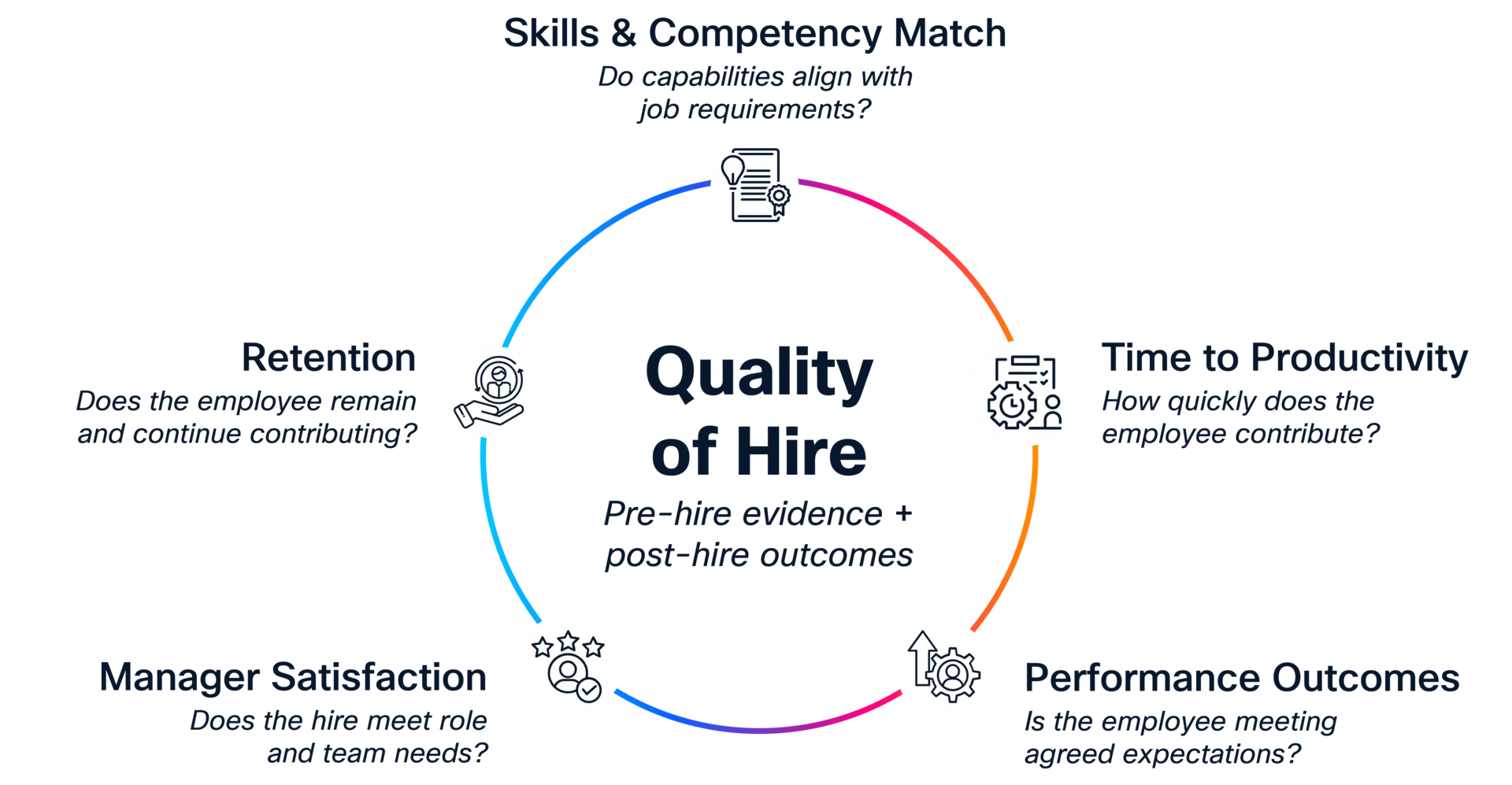
The indicators shown should be adapted to the role, market, and organization, with appropriate measures and review points defined for each context.
The goal is not to find a perfect number, but to identify which hiring practices consistently produce stronger outcomes and use those insights to make better decisions in the future.
Why Quality of Hire Matters
Quality of Hire affects far more than recruiting.

When a hiring decision is successful, organizations can benefit from:
- Faster productivity
- Stronger team performance
- Better employee retention
- More effective use of manager time
- Improved employee experience
- Greater workforce stability
When hiring decisions fall short, the impact can extend well beyond talent acquisition through delayed projects, increased onboarding costs, additional hiring effort, and lost productivity.
This is why Quality of Hire should complement, not replace, recruiting efficiency metrics.
Time to fill tells you how quickly a role was filled. Quality of Hire helps you understand whether that hiring decision ultimately delivered value.
Recent Gartner research highlights the growing importance of Quality of Hire as organizations seek better ways to demonstrate recruiting's business impact and understand the value employees create after they join [gartner.com].
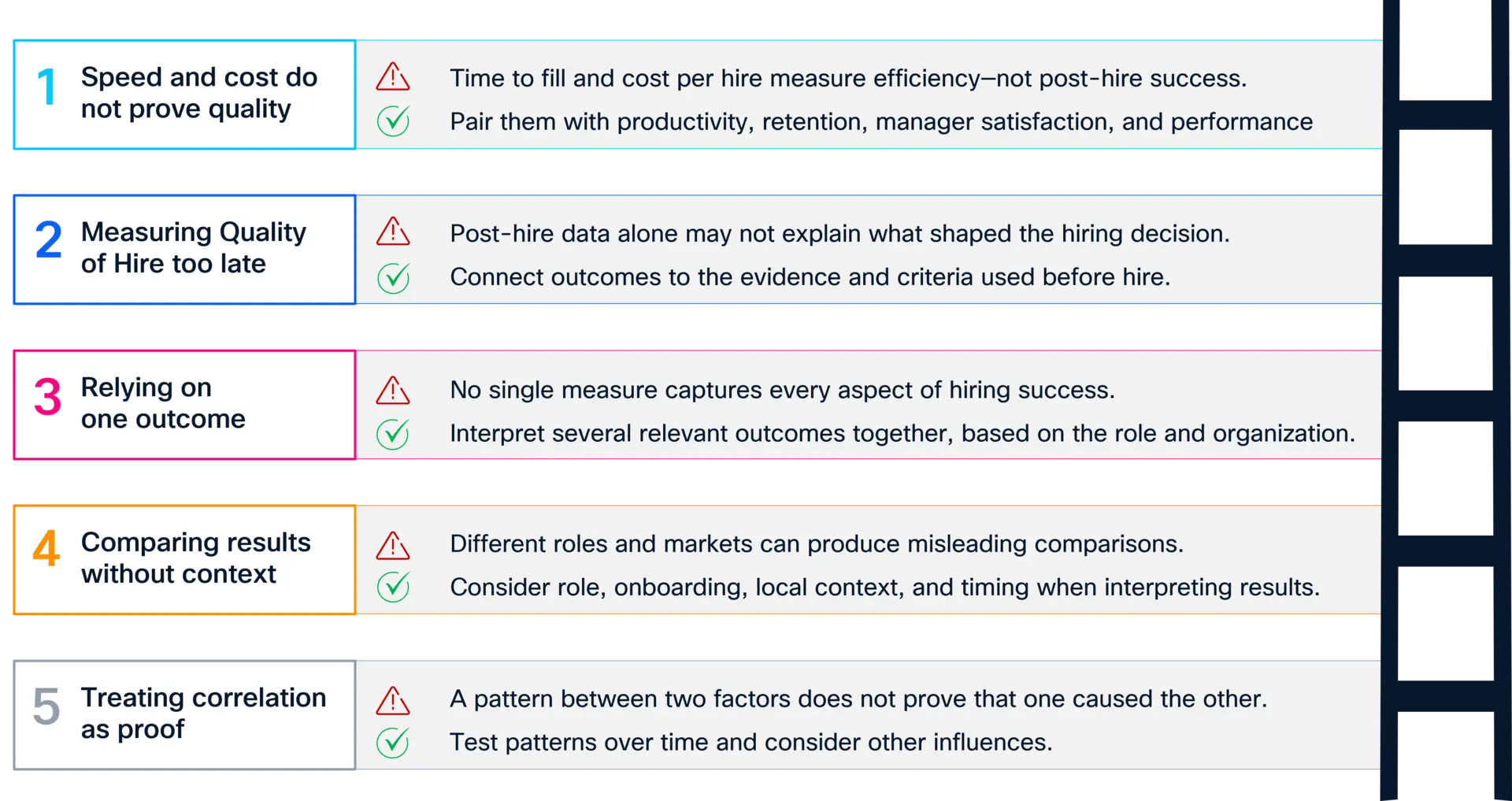
Five Quality-of-Hire Challenges—and How to Overcome Them
Quality of Hire can suffer when teams rely on incomplete signals, focus on the wrong metrics, or fail to examine what happens after hiring. A strong interview or well-known background may provide useful information, but neither shows on-the-job success on its own.
Quality-of-Hire data becomes more valuable when it is interpreted in context and connected to longer-term outcomes.
The five steps below highlight common challenges and practical ways to address them.
Four Practical Ways to Improve Quality of Hire
Quality of Hire can vary across roles, teams, and markets.
While there is no universal formula or single metric, organizations with consistently stronger hiring outcomes tend to use a structured approach to define success, evaluate talent, and measure results.
The following practices can help strengthen hiring decisions and support better long-term talent outcomes.
1. Define Success Before Defining Requirements
Many hiring teams start by listing qualifications. Stronger hiring teams start by defining success.

Before opening a role, ask:
- What should this person accomplish in their first 90 days?
- What outcomes should they deliver within the first year?
- Which skills are essential on day one versus teachable over time?
Defining clear success criteria upfront aligns hiring teams from sourcing through onboarding, clarifying role requirements and interview focus while creating a reliable benchmark for measuring long-term Quality of Hire.
2. Focus on Evidence, Not Just Experience
While past experience has value, it is often an incomplete predictor of future success for early-career talent, whose potential is often better reflected in demonstrated skills than in years on a resume.
Instead of asking only:
- How much experience does this candidate have?
Also ask:
- What evidence suggests this candidate can succeed in the role?

Evidence may include:
- Applied Experience: Internships, apprenticeships, freelance projects, open-source contributions, and hands-on lab work.
- Practical Projects: Technical portfolios, GitHub repositories, hackathons, bootcamps, and university capstones.
- Verified Qualifications: Industry certifications, verified digital credentials, micro-credentials like Cisco Networking Academy, and accredited assessment-validated technical training.
Evaluating demonstrated skills gives hiring teams a far stronger signal of true capability than relying solely on job history, opening doors to high-potential talent traditional screening methods miss.
3. Bring Consistency to Hiring Decisions
Organizations do not need identical hiring processes for every role or market. However, candidates should be evaluated against the same core requirements for a given position.
Consider:
- Structured interview questions
- Consistent evaluation criteria
- Clear scoring guidance
- Documented hiring rationale
A useful question to ask is:
- Would different interviewers reviewing the same information be likely to reach a similar conclusion?
Standardizing your hiring process doesn’t replace human judgment—it gives teams a consistent way to evaluate role-relevant evidence, reducing interviewer variation and enabling more informed hiring decisions
4. Measure Outcomes, Not Just Activity
Although traditional recruiting metrics offer useful insight into application volume, pipeline size, and time to fill, measuring Quality of Hire requires looking beyond recruiting activity to assess whether hires deliver meaningful long-term business outcomes.

To understand Quality of Hire, review indicators such as:
- Time to productivity
- 90-day retention
- Hiring manager satisfaction
- Skills and competency alignment
- Performance against role expectations
Then ask:
Which hiring signals are most closely associated with success after hire?
The answer can help strengthen future hiring decisions, improve hiring processes, and create a clearer connection between recruiting efforts and business outcomes.
Where Talent Bridge Can Help
For employers hiring early-career talent, limited experience can make it harder to assess the skills, potential, and readiness linked to post-hire success.
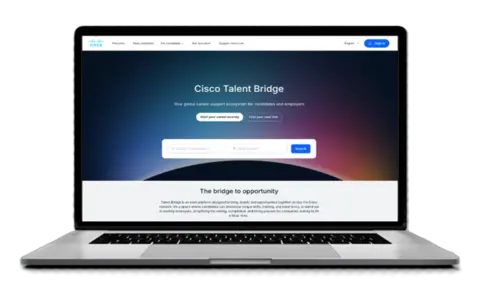
Cisco Talent Bridge brings together candidates’ skills, credentials, learning achievements, and experience, helping hiring teams evaluate capabilities against role requirements more consistently.
Through its AI-powered platform and access to a global pool of skilled talent from Cisco Networking Academy and beyond, Talent Bridge supports a broader skills-focused hiring strategy and more informed hiring decisions, as outlined in the table below.
How Talent Bridge Supports Better Hiring Decisions
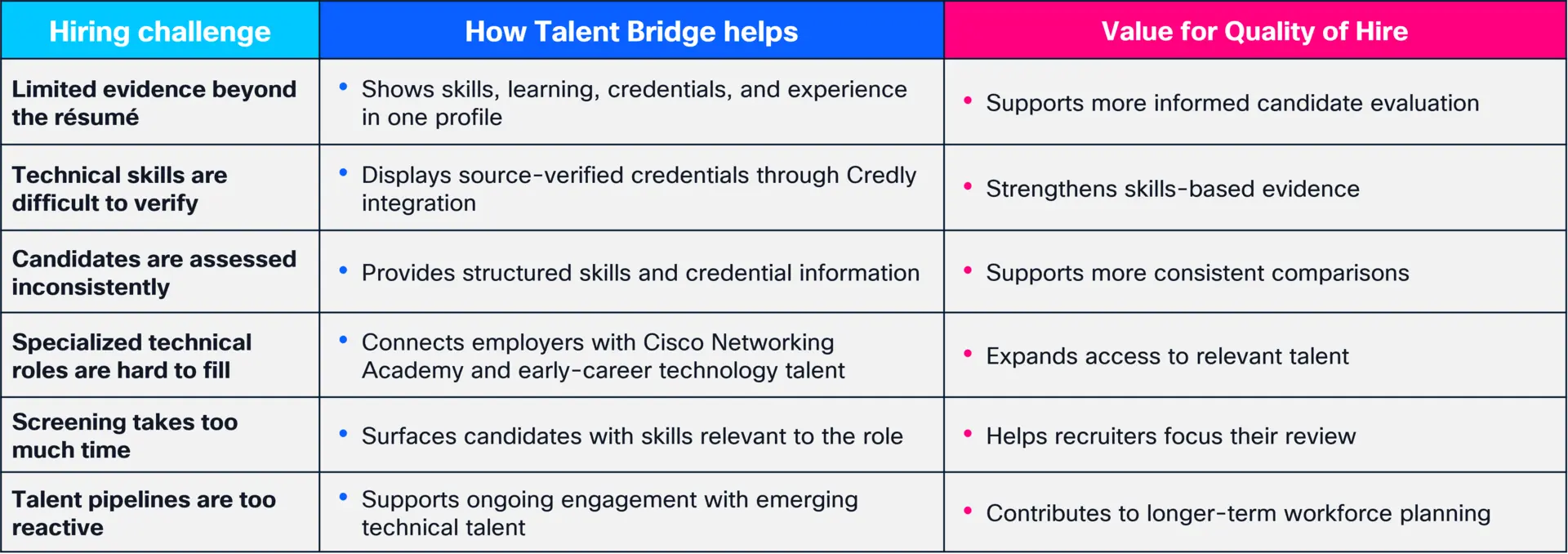
Talent Bridge is one part of a broader Quality of Hire strategy. It gives organizations a practical way to connect workforce needs with relevant early-career talent and turn hiring priorities into action.
A Simple 90-Day Starting Plan
Improving Quality of Hire does not require rebuilding your entire hiring process.
This 90-day plan provides a practical path toward structured, measurable hiring outcomes and continuous improvement—giving you a flexible blueprint to adapt across your roles, markets, and organizational priorities.
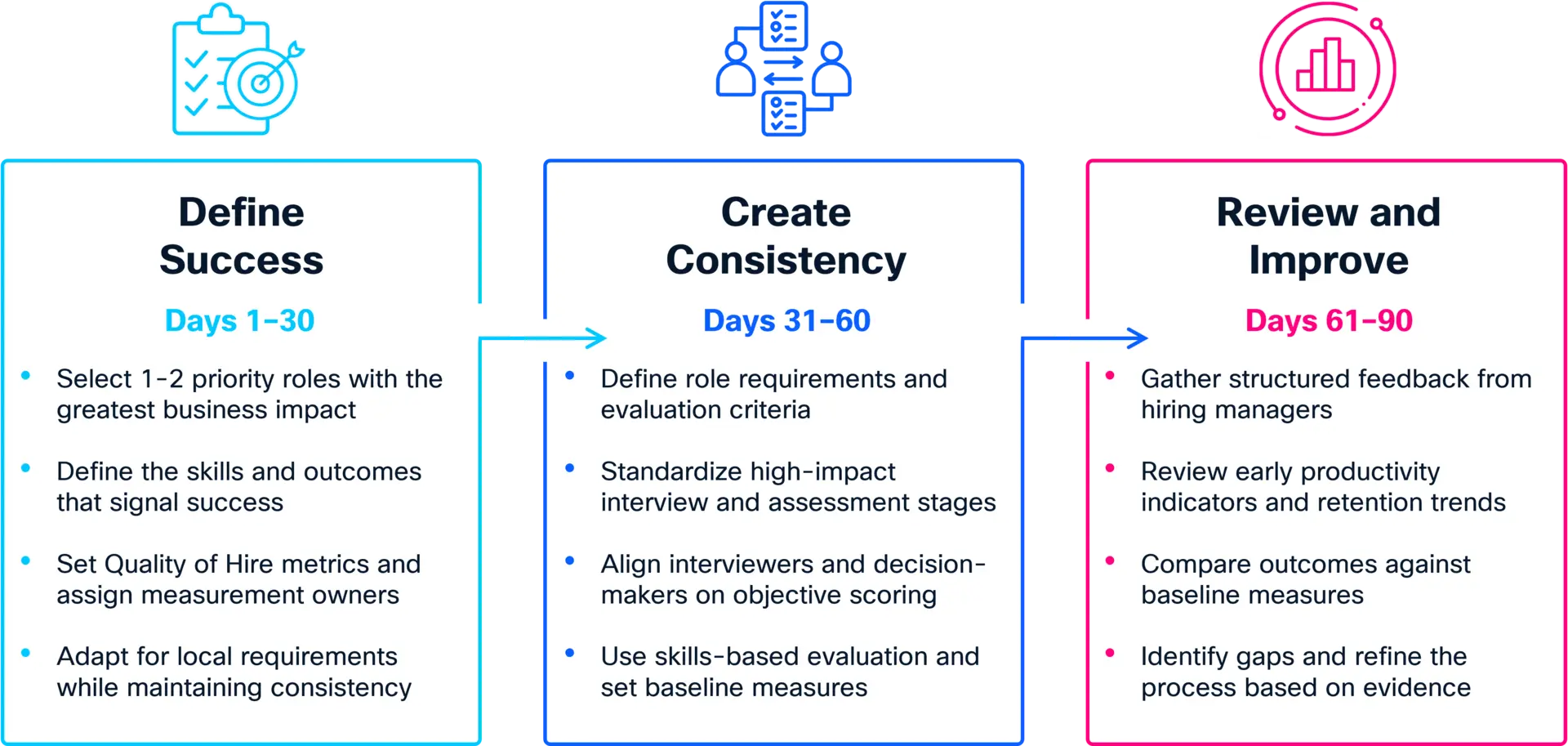
Keep in mind: 90 days provides valuable early performance signals, but it will not reveal every aspect of Quality of Hire. Some roles may require longer observation periods before meaningful conclusions can be drawn.
The Bottom Line
Improving Quality of Hire goes beyond filling roles quickly.
It starts with defining what success looks like for each role, then using relevant evidence and structured processes to make informed hiring decisions that support long-term performance, retention, and meaningful contribution.
Cisco Talent Bridge supports this approach through skills-based hiring.
With access to global, job-ready early-career talent and verified credentials through Credly integration, hiring teams can consider a candidate’s skills, learning, and experience together—gaining a clearer view of their capabilities than traditional screening alone.
Ready to improve your Quality of Hire?
Start with one open role: define success, decide how to measure it, agree on objective evaluation criteria, and explore how Cisco Talent Bridge can support a more consistent, informed hiring process.
References:
- Gartner, Quality of Hire Reimagined: Defining and Measuring Talent Value (2026, August 24). [gartner.com] (Note: The original report is accessible to subscription holders on the Gartner Portal.)
This article reflects general hiring guidance informed by global industry practices. Because employment
regulations, data requirements, and hiring norms vary by country, organizations should review hiring processes
and decisions with their local HR and legal teams to ensure alignment with applicable requirements.